Institutional Risk Analytics & UI Architecture
Restructured an enterprise commodity risk dashboard around trader intent rather than raw data volume, turning a dense reporting surface into an operational decision-making tool.
Industry
Energy & Risk Analytics
Services Delivered
Performance Audit, Design System & Architectural Strategy
Technologies Used
TypeScript, SvelteKit, Highcharts, RESTful API, PostgreSQL, SASS
The Challenge
Mobius Risk Group operates RiskNet, an enterprise platform used by energy traders and large organizations to monitor market exposure and execute complex commodity trades. When we engaged, their dashboard surfaced accurate data behind an interface that made fast, confident decisions nearly impossible.
RiskNet's legacy dashboard buried its most valuable data under layers of unprioritized information. Users were forced to manually interpret market state across a cluttered interface rather than act on clear signals, creating dangerous delays in time-sensitive financial decisions. The platform had the right data but completely failed to deliver it as an operational tool.
Diagnosis
An architectural review confirmed the root cause was structural, not cosmetic. The dashboard was organized around data availability rather than user intent. We established a strict collaboration workflow with Mobius's internal backend team to ensure every new interface decision reflected actual system behavior and financial data constraints before a line of code was written.
The Solution
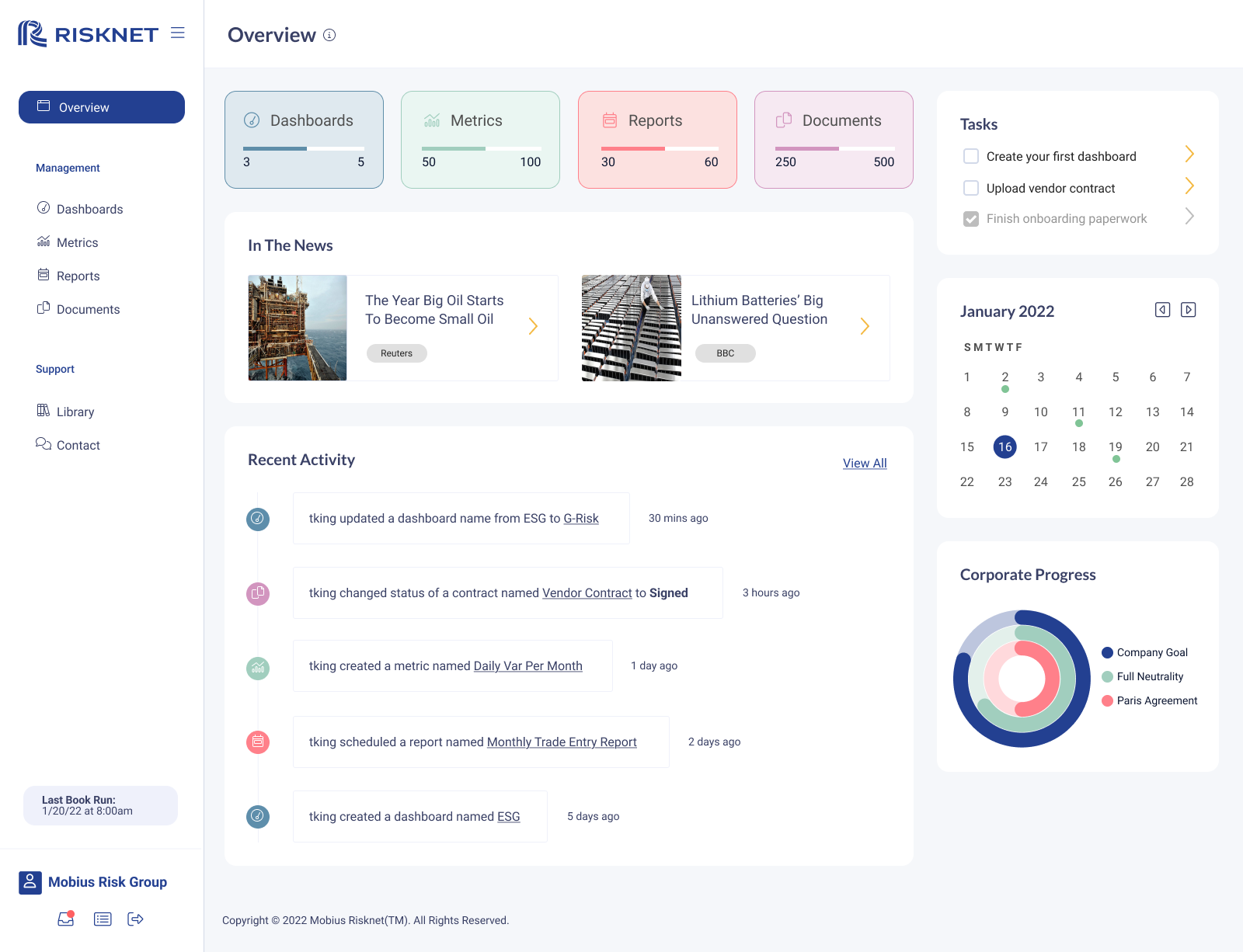
We led the comprehensive redesign of the platform's user interface architecture, reframing the dashboard entirely around system state and user intent rather than raw data presentation. To accomplish this, we built a comprehensive component library and design system that standardized the visual language across the entire application.
By codifying these design rules, we transformed the dashboard from a static data warehouse into a high-performance, interactive framework. We ensured that the new architecture strictly maintained the platform's enterprise-grade, SSAE-compliant security standards while optimizing the rendering path for complex data tables.
The Outcome
- [1]
Traders act on signals, not noise
By organizing the dashboard around system state and user intent rather than raw data volume, the redesign eliminated the context-switching that was slowing financial decisions. The right information surfaces at the right moment.
- [2]
Support questions changed
Internal support inquiries stopped being about navigation and started being about strategy. When users can operate a platform without asking how, the interface is working.
- [3]
A reporting tool became an operational one
The new component library codified the rules of the interface, ensuring that as RiskNet scales, every new surface reflects the same data hierarchy and visual logic. Static reporting became an intent-driven framework.
Ready to Scale?
Discuss how Fieldset can engineer a deterministic path for your next phase of growth.